Friday, August 20, 2010

Monster Revealed


I love it when things happen the way they’re supposed to. This happened yesterday. Just as promised (and as in any good scary story) our monster shed his ‘scales’ only to expose an inner sweet self. The fruit looks like corn-on-the-cob. The ‘kernels’, exposed after the scales peel away, start to protrude and you can either pick them from the ‘cob’ or use a fork to tease them into a bowl. In this case, two bowls.

Sylvia’s review? “Tastes like gummy candy.” My take? A beautiful blend of pineapple and banana flavors. Not scary at all, just thoroughly tropical and monstrously delicious.

Monday, August 16, 2010

Waiting for the Monster (fruit)


Here’s another addition to the annals of weird fruit. Well, weird to us. My guess is that this tropical fruit might be standard fare if you lived near it's rainforest origins in Mexico or Panama. This particular fruit (the one in the photograph) was purchased at the Food Coop earlier today and was grown in Florida. That's not exactly meeting locavore requirements, but it didn't need a passport either. I hope you’ll forgive me! I can only explain my desire for the exotic by saying that small adventures are substituting for bigger ones these days.

But back to our Monster… this morning I passed over one of its companions because the skin wasn’t looking as smooth and unblemished as this one (using the usual principles for fruit buying). Well, it turns out that the less attractive bin mate was closer to being ripe. This is a work in progress. Just as in an earlier entry about Ugli Fruit, we are going to have to revisit this edible adventure when it’s ripe. In the mean time, the instructions wrapped around our monster (Creature from the Black Lagoon comes to mind, which was, by the way, one of the first movies to be released in 3D), tells me to keep it upright, stemside up in a glass, until the scales drop off by themselves. We are in this together! I’ll report back when Monstera Deliciocia transforms into a tasty tropical delicacy.

Thursday, August 12, 2010

Planets, Peaches, Donuts and Emperors


Unlike the core of Saturn that is filled with iron, nickel, silicon and oxygen compounds, Saturn Peaches are filled with fruit that has delicate almond undertones (the almond is a relative of the peach) and is sweeter than the usual variety. What are the other advantages (apart from not requiring space travel)? They are not as fuzzy as a regular peach and the stone (pit) doesn’t cling to the inside flesh the same way it does in an ordinary peach. Less mess at the core. They are a hardier shape, easier to hold and easier to squeeze into your lunchbox!

Saturn peaches were introduced to the Western World from China in 1869. A Saturn peach in China during the 1800’s, could only be planted in the royal grounds of The Emperor. There was a lot of unrest in China at this time. It’s nice to think that once in a while there was a break for these lovely peaches… a donut break! Which is the other name that you will find applied to these lovely fruits.

Mother Earth News has an article called Top 10 Reasons to Try a Donut Peach. They also have an article, ‘Saturn’ Peaches, that has a little more about how this Chinese fruit tree was adapted to be more cold hardy. All of which explains why this peach, with out-of-this-world sweetness, is now readily available to Emperors and mere commoners here on earth.

Monday, August 9, 2010

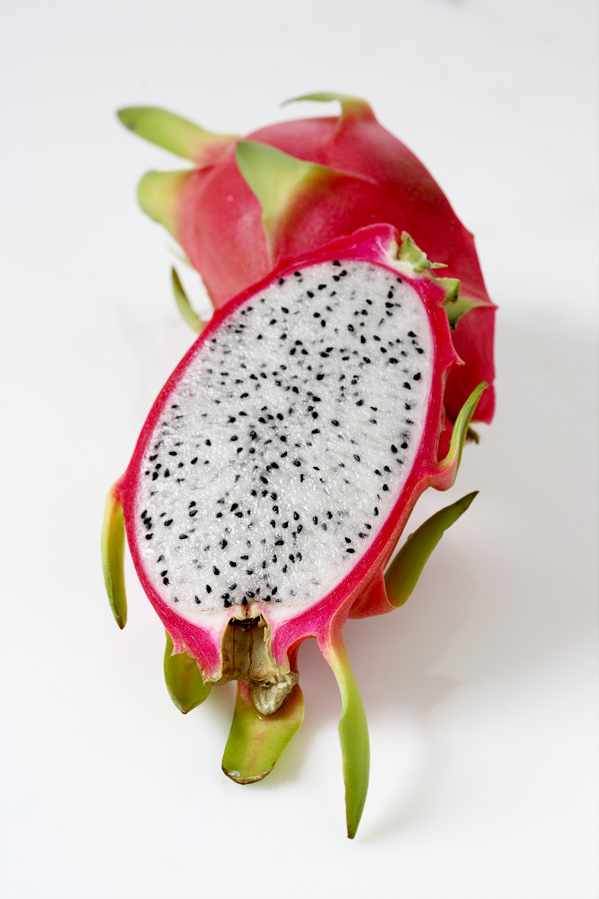
Adventure! Mystery! Dragon Fruit!


Who could resist? Sylvia had an appointment close to China Town and after we had taken care of business, it was either go home or seek adventure. We had no way of knowing that our decision would lead us to this unearthly discovery. OK, OK…. we were in search of something new, and this being New York, you can pretty much bet that if you want an adventure, all you need to do is put one foot in front of the other and go!

These were on fruit stands everywhere. By the time we had explored the Chinese market underneath the Manhattan Bridge, enjoyed soup dumplings at Joe’s Shanghai Restaurant (our server was very happy to demonstrate the proper eating method… that is after we survived the agony of watching our table mates consume massive quantities before our order arrived), and discovered a beautiful shop dedicated to chopsticks (I have already placed my Christmas request), we were on a roll. So far everything had been delightful the thrill of adventure made passing over these rare looking fruits impossible.

Actually, after a bit of research, it turns out that Dragon Fruit is not all that rare. You probably won’t find it at your local supermarket, and because it’s tropical you certainly won’t find it at the Farmer’s Market (I do feel a bit sheepish about buying a ‘passport required’ food, but we were in discovery mode!). It turns out that South America, Asia, Australia and Hawaii all produce pitaya. The fruit of a cactus plant, this pink and green one is called Sweet Pitaya. According to a Dragon Fruit web site, these beautiful fruits require bats to successfully pollinate. The flowers necessary for pollination bloom at night, and bats are the night shift! This is possibly the first time the thought of bees needing to sleep has even occurred to me.

Our impulse purchase was similar to Kiwi and mild. I enjoyed my half, Sylvia wasn’t so keen, but did not find it objectionable either. Her half is in the fridge cooling down… we are going to see if it’s more appealing chilled. The reward for being adventurous is eating a fruit that is full of fiber, antioxidants and vitamins. Low in calories too!

End of the day assessment? All in all a successful adventure and another food mystery solved!

Thursday, August 5, 2010

Not Quite Nicoise


It’s still very hot in Brooklyn (who says there’s no such thing as Global Warming?). This means that we are still in our ‘Salad Days’. Salad in summer is the counterpart to soup in winter. You can make something special to recipe, or simply scour the supplies on hand to invent something yourself.

A Nicoise salad is a famous main course ‘composed’ salad that has potatoes, beans, eggs, tomatoes, tuna, anchovies, capers and its namesake, Nicoise olives. All this wonderful stuff rests on lettuce lightly dressed with a lemony dressing. Sounds great, doesn’t it? (OK, you can skip the anchovies, but you are really missing something… that goes for the capers too)

That said, rather than get all worked up about making an authentic recipe, I’d like to encourage you to make a Not Quite Nicoise. Get out your biggest bowl and start with the main structure, lettuce and some sort of dressing (here’s the Dijon dressing that we learned about). Now gather anything you like (within reason, let’s not get too silly). Most pantries have a can of tuna (drain it before using), an onion (purple? peeled and sliced very thin?), a sliced hard-boiled egg, maybe some beans and potatoes. Blanch the beans the way we cooked the Edamame. A simple guide to cooking potatoes follows. Get ready to assemble the ingredients and guess what? You’ve almost got a meal! All you need to do now is text a few friends and have them to stop by the bakery to get a nice loaf of bread. Wait until they arrive, dress the lettuce just before serving and compose (yourself)!


Boiled Potatoes
(I recommend small red or yellow ones with thin skins. Try to buy spuds of a similar size)
  • Wash your potatoes and cut out any ‘eyes’ (small sprouts)
  • You can cook them whole or cut them in quarters or similar sized pieces
  • Place potatoes in a deep pot with cold water to cover and a large pinch of salt
  • Bring to a boil (large rolling bubbles)
  • Cook until tender. A skewer or sharp knife will go in easily when they are done. Try not to cook them into mush.
  • Drain and let cool. This can be done way in advance and can be refrigerated in a tightly covered container for up to 3 days.

Footnote: I didn’t mention peeling, because I like the skins. It’s your choice!

Friday, July 30, 2010

Whisk-y Business


FYI, this is a whisk (well, two of them and a bowl. The later of which is usually employed at the same time).

If this blog is truly dedicated to the basics, then this is something you should know about. On top of the list of essential kitchen tools, the whisk keeps company with a good knife and a spoon. Craig Claiborne, (who is famous for educating Americans in all things kitchen) touts a medium wire whisk second only to a cast iron pan when he writes of “The Most Basic Equipment for a Small BASIC Kitchen”.

New Kitchen Primer was inspired by Craig Claiborne’s Kitchen Primer, which is a small volume that was originally published in 1996 by Portland House. I got my copy used via EBay, and it’s really brand new (didn’t cost much either). If you can get your hands on this compact volume, I highly recommend it. Trends in cooking change as much as hemlines (or if that analogy doesn’t work for you ….as much as cell phone technology), so his recipes may seem a little heavy in the cream and butter department. That said, the list of kitchen essentials and the advice on use of equipment is great. Nice little illustrations too.

But back to whisks. I’ll risk being a bore and remind you, once again, to buy the best you can afford at a proper kitchen supply. A cheap whisk doesn’t work very well and will not last. A quality whisk will last forever and will always be a pleasure to use. Just think about how amazing you will feel as you use your beautiful new kitchen tool to ‘whisk up’ a lovely salad dressing or some eggs or even some whipped cream… and that’s just the beginning.

Also FYI, when you are ‘whisking something up’, do yourself a favor and use a much larger bowl or vessel than you think you need. This will equate to more freedom of movement (sometimes you really want to get some momentum going) and most certainly less mess.

You're ready for wisk-y business!

Tuesday, July 27, 2010

Living with Zest


It is possible to live without zest. Why one would want to is another matter entirely. Unlike the profound variety, as in joie de vivre (joy of life) zest, citrus zest is not dependent on mood. It’s simply dependent on a handy little tool aptly named a ‘zester’. Scrape its row of tiny blades along the rind of an orange, lime or lemon and voila! You have zest! This is so easy that it might even make you feel zesty in a more life altering way.

Bakers often use zest in cakes or other delights (maybe there is a direct relation after all), but for a beginning zest maker, here’s a recipe from Food and Wine that uses lemon zest in a salad dressing. (For all you non-cook cooks, this simple dressing might liven up your salad repertoire.)

Tools
  • Measuring spoons
  • A zester (review kitchen-purchasing advice and go to a real cook shop. This will be your zester for life)
  • A sharp knife or something else that chops
  • A whisk (if you don’t have one… same advise goes. Buy the best you can afford.)
  • A small bowl
Ingredients
  • 1 Tablespoon plus 2 teaspoons of lemon juice
  • 1 teaspoon of finely chopped lemon zest
  • 1 Tablespoon of honey
  • 1/2 teaspoon of chopped Thyme
  • 1/4 cup of extra-virgin olive oil
  • Your best salt and some freshly ground pepper to taste
Method
  • In a small bowl, whisk together the juice, zest, thyme and honey.
  • Whisk in olive oil and season with salt and pepper.
Find some salad greens and you are living with zest!!!

PS There are plenty of links in this one for review. This is the 141st blog entry...Can you believe it?!