Showing posts with label Fruit. Show all posts

Friday, August 19, 2011

Lychees


At the moment, you could make the argument that New York is tropical.  That’s an over-heated brain talking.  This may be cruel, but remember winter? I usually write about the seasonal and local this time of year, but couldn’t resist these beautiful tropical fruits. After all, Lychee are not local to us, but they are local somewhere (I heard once that there is a world outside of Brooklyn). Also, chinatown has these in stands everywhere so it’s certain that in some spots on the planet Lychee are in season as well. Chances are you will be able to find these plum sized tropical fruits in your own alternate shopping universe.

Intrigued (just a little)?  What do you really need to know?  Just like cherries, Lychee are picked when ripe and do not improve after harvest.  Choose them intact and red to pink in color.  Unlike cherries, they will keep for a couple of weeks.  If you don’t have a cool place in your kitchen, they are best stored loosely in a perforated plastic bag in the refrigerator.  The pretty pink shell color will turn brown, but the interior fruit will remain juicy and ready to eat.  Splitting the shell carefully with either your fingers or a knife, and carefully peeling it away, pale white flesh will be revealed.  Sweet and pleasantly floral, full of vitamin C and with healthy amount of potassium, lychees will sooth even the most over-heated culinary adventurer.  Don’t eat the seed and don’t worry about winter…. plenty of time for that!

Friday, August 12, 2011

Ah… Bings!


Besides choosing firm, fleshy, glossy plump fruit with stalks that are not dried-up, what do you need to know about cherries? There are two types, the sweet, eat-as-is-type that you see in the photo and sour cherries that are used for pies and other delights.  For our purposes let’s stick with the eat-now variety.

Cherries do not improve after being harvested, which means that they are ripe at harvest and fragile, an exemplar of the seasonal.   If you haven’t eaten your cherries already (they don’t last long in this house), refrigerate them loosely in a bag with holes and away from strong smelling foods.  Don’t let them languish there too long.

The cherries in this photo were both labeled as "Bing" at the supermarket.  The dark red is the classic Bing.  My favorite food geek, Harold McGee, writes that the deep red fruits contain more antioxidants, which means that they are very good for you.  The California Cherry site makes all sorts of health claims.  Naturally they have a vested interest in extolling the virtues of cherries, but who can resist believing all of it with such a lovely and delicious fruit?

What you don’t need to know, but what is fun and interesting, is that Bing cherries were named after Ah Bing, a Manchurian Chinese foreman who helped the horticulturist Seth Lewelling in the late 1800’s develop this particular variety. 

Ahhhh…. Bings!

Friday, July 1, 2011

White Currants


Once in a while one simply has to respond to beauty.

These diminutive white currants were today’s find from the Coop.  Not sure what to do with them just yet.  A little bit of research in Harold McGee’s book, On Food and Cooking, tells me that currents in general have growing restrictions in the United States.  This is because currants can carry a disease that affects white pines.  It’s difficult to imagine such jewel-like fruit doing harm to anything, but does explain why currants, especially black currants, are more common in England.  Perhaps their laws are not nearly as severe.  Currants in general are used more in France and the UK. 

The berry I sampled from this lot was a little bitter.  Was I disappointed?   Somewhat.  That said, having these in front of the camera today made me stop, observe and be in the moment.  Maybe they won’t make dessert, but they were responsible for a much-needed pause, and just a little bit of quiet before July 4th and spectacles of a grander sort.  Whether your weekend is full of loud or quiet moments (or both), enjoy!

Monday, August 30, 2010

It’s a Tomato! It’s a Cherry! It’s a Cape Gooseberry!


Also known as a Ground Cherry, this super little fruit (that’s a relative of a tomatillo) references Superman in more ways than one. Apart from having a ‘Cape’ attached to it, this cherry sized fruit contains a chemical, Cryptoxanthin. But fear not! This is not Kryptonite! Cryptoxanthin converts to vitamin A, which equates with its having anti-oxidant properties. I’m sure that Superman would have enjoyed these as a snack. He would have been able to swoop down in either North or South America where these are native. When you fly around and have superpowers, this is the bonus you get for having to fight bad guys most of the time. Maybe he picked some for Lois to use in a salad or enough for her to make preserves or a pie (who knows? maybe Superman likes to cook too!).

You and I don’t need a cape or superpowers to try these. All that’s required is a willingness to try something new and a trip to the farmer’s market. Just peel back the husk and eat the berry inside. You’ll be able to report back to your friends on this planet that it’s slightly tart, slightly sweet and very mild mannered.

Friday, August 20, 2010

Monster Revealed


I love it when things happen the way they’re supposed to. This happened yesterday. Just as promised (and as in any good scary story) our monster shed his ‘scales’ only to expose an inner sweet self. The fruit looks like corn-on-the-cob. The ‘kernels’, exposed after the scales peel away, start to protrude and you can either pick them from the ‘cob’ or use a fork to tease them into a bowl. In this case, two bowls.

Sylvia’s review? “Tastes like gummy candy.” My take? A beautiful blend of pineapple and banana flavors. Not scary at all, just thoroughly tropical and monstrously delicious.

Monday, August 16, 2010

Waiting for the Monster (fruit)


Here’s another addition to the annals of weird fruit. Well, weird to us. My guess is that this tropical fruit might be standard fare if you lived near it's rainforest origins in Mexico or Panama. This particular fruit (the one in the photograph) was purchased at the Food Coop earlier today and was grown in Florida. That's not exactly meeting locavore requirements, but it didn't need a passport either. I hope you’ll forgive me! I can only explain my desire for the exotic by saying that small adventures are substituting for bigger ones these days.

But back to our Monster… this morning I passed over one of its companions because the skin wasn’t looking as smooth and unblemished as this one (using the usual principles for fruit buying). Well, it turns out that the less attractive bin mate was closer to being ripe. This is a work in progress. Just as in an earlier entry about Ugli Fruit, we are going to have to revisit this edible adventure when it’s ripe. In the mean time, the instructions wrapped around our monster (Creature from the Black Lagoon comes to mind, which was, by the way, one of the first movies to be released in 3D), tells me to keep it upright, stemside up in a glass, until the scales drop off by themselves. We are in this together! I’ll report back when Monstera Deliciocia transforms into a tasty tropical delicacy.

Thursday, August 12, 2010

Planets, Peaches, Donuts and Emperors


Unlike the core of Saturn that is filled with iron, nickel, silicon and oxygen compounds, Saturn Peaches are filled with fruit that has delicate almond undertones (the almond is a relative of the peach) and is sweeter than the usual variety. What are the other advantages (apart from not requiring space travel)? They are not as fuzzy as a regular peach and the stone (pit) doesn’t cling to the inside flesh the same way it does in an ordinary peach. Less mess at the core. They are a hardier shape, easier to hold and easier to squeeze into your lunchbox!

Saturn peaches were introduced to the Western World from China in 1869. A Saturn peach in China during the 1800’s, could only be planted in the royal grounds of The Emperor. There was a lot of unrest in China at this time. It’s nice to think that once in a while there was a break for these lovely peaches… a donut break! Which is the other name that you will find applied to these lovely fruits.

Mother Earth News has an article called Top 10 Reasons to Try a Donut Peach. They also have an article, ‘Saturn’ Peaches, that has a little more about how this Chinese fruit tree was adapted to be more cold hardy. All of which explains why this peach, with out-of-this-world sweetness, is now readily available to Emperors and mere commoners here on earth.

Monday, August 9, 2010

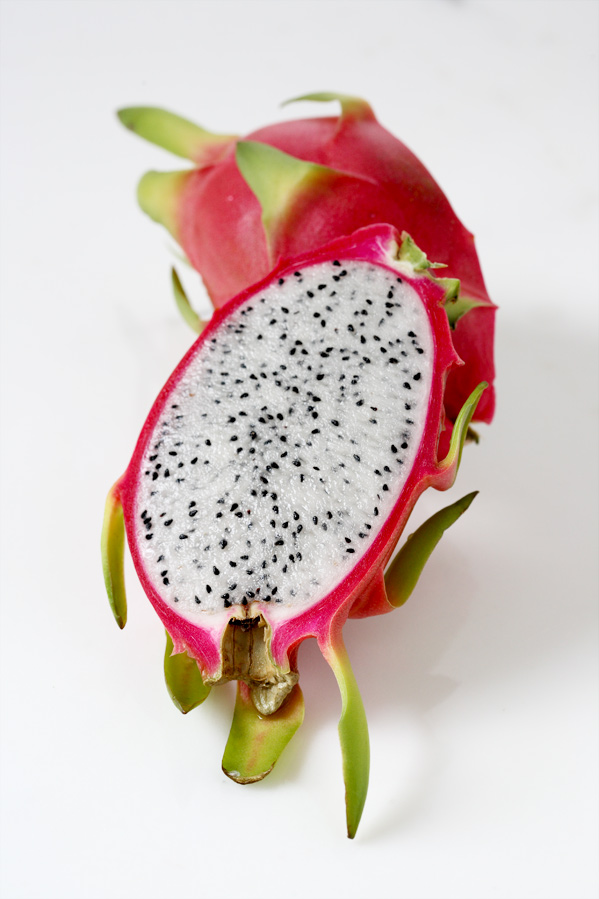
Adventure! Mystery! Dragon Fruit!


Who could resist? Sylvia had an appointment close to China Town and after we had taken care of business, it was either go home or seek adventure. We had no way of knowing that our decision would lead us to this unearthly discovery. OK, OK…. we were in search of something new, and this being New York, you can pretty much bet that if you want an adventure, all you need to do is put one foot in front of the other and go!

These were on fruit stands everywhere. By the time we had explored the Chinese market underneath the Manhattan Bridge, enjoyed soup dumplings at Joe’s Shanghai Restaurant (our server was very happy to demonstrate the proper eating method… that is after we survived the agony of watching our table mates consume massive quantities before our order arrived), and discovered a beautiful shop dedicated to chopsticks (I have already placed my Christmas request), we were on a roll. So far everything had been delightful the thrill of adventure made passing over these rare looking fruits impossible.

Actually, after a bit of research, it turns out that Dragon Fruit is not all that rare. You probably won’t find it at your local supermarket, and because it’s tropical you certainly won’t find it at the Farmer’s Market (I do feel a bit sheepish about buying a ‘passport required’ food, but we were in discovery mode!). It turns out that South America, Asia, Australia and Hawaii all produce pitaya. The fruit of a cactus plant, this pink and green one is called Sweet Pitaya. According to a Dragon Fruit web site, these beautiful fruits require bats to successfully pollinate. The flowers necessary for pollination bloom at night, and bats are the night shift! This is possibly the first time the thought of bees needing to sleep has even occurred to me.

Our impulse purchase was similar to Kiwi and mild. I enjoyed my half, Sylvia wasn’t so keen, but did not find it objectionable either. Her half is in the fridge cooling down… we are going to see if it’s more appealing chilled. The reward for being adventurous is eating a fruit that is full of fiber, antioxidants and vitamins. Low in calories too!

End of the day assessment? All in all a successful adventure and another food mystery solved!

Saturday, July 17, 2010

Gowanus Botanical Garden Report: A Tomato!!


Well, this is it, possibly the world’s smallest tomato farm. What you see is the season’s entire tomato production. Honestly? I’m surprised that we got this far. Historically the squirrels get first pick and one determined garden beast would have annihilated the entire crop. Maybe next year I will hazard a larger, more productive plant!

Did I mention that tomatoes are actually a fruit? We like to think of them as vegetables because of their low sugar content and their high amount of glutamic acid and sulfur aromas, chacteristics that are more common in savory foods (pardon the food geek moment).

So apart from taste, what’s so great about a tomato? It’s very rich in vitamin C and delivers a big dose of the antioxidant carotenoid lycopene, which is thought to fight cancers.

I’ve written about tomatoes before, so if you are feeling like a review, here are the links:

Hercules and Hydroponics
Quick! Before it’s Winter!

What follows is a non-cook cooking recipe and my favorite summer salad. It’s called Caprese and is always wonderful.

Caprese Salad

  • Alternate slices of fresh tomato and fresh mozzarella on a plate
  • Drizzle (control yourself!) with Extra Virgin Olive Oil and Balsamic Vinegar (or skip the vinegar)
  • Season with freshly ground pepper, a dash of your best salt and fresh Basil Leaves

Bon Appitto!

Friday, July 9, 2010

Raspberries and Entanglement


So get this! Raspberries inspired Velcro! Now there’s a ‘learn something new everyday’ moment! I wanted to encourage you to eat more berries and felt that I might get boring and end up doing a repeat of the last entry. You know, the one that heralded the virtues of blueberries.

Actually, raspberries are way more fragile than blueberries. Again, look for firm (and in this case glossy) fruit that is loosely packed (to discourage mold, which you should be on the look-out for) and eat ASAP!!!! (That’s As Soon As Possible) These guys are very tender. Cathy (the pastry chef sister) tells me that if you eat them little cell by little cell, you will experience small bursts of flavor on your happy tongue.

Cherie contradicts me by saying that thistles, not raspberries, inspired Velcro!

Controversy is always energizing. Harold McGee writes that Caneberries (the berry family that Raspberries belong to) are composite fruits, meaning that they consist of many many small entities that are held together by an ‘entanglement’ (now there’s a word that you might have fun with) of hairs…. hence the Velcro inspiration.

But you know what? Thistles or Raspberries being the source of inspiration or not, these amazinging beautiful and flavorful berries are worth eating. They are good for you (one of the biggest deliverers of anti-oxidants) and a delight to eat. AND they are currently in season. We had them last night with vanilla ice cream. Dessert couldn’t have been simpler or better!

Wednesday, July 7, 2010

Blueberries


I’m skipping a clever title for this straightforward food. No cooking necessary. Store in the refrigerator. Lightly wash just before eating. Look for firm, unwrinkled berries with no sign of mold (if you are buying them in clear box look at the underside). Eat them straight up, on cereal or throw some in a fruit salad or pancake batter.

Don’t even pay attention to the fact that you are consuming a terrific source of vitamin C and potassium. Fiber too. (Bonus points for those who care)

Brooklyn is currently experiencing a heat wave. This is the best possible time to non-cook. I think I’ll start with a handful of berries. The models for this picture are already history!

If you want to know more, here's the Wiki link to Blueberries

Thursday, June 10, 2010

Whoa! Not those sorts of Peaches!


Just looked at my favorite two sources for information. First, I checked in with food writer Harold McGee. His book, On Food and Cooking, is about the geekiest (and most fascinating) food reference around. Harold writes that Peaches were named after Persia (the name of Iran before 1935) and that when peaches ripen, they do it from along the stem end and the ripening travels along the groove…. interesting but not as groovy as what Wikipedia has to say (which is my next favorite place to get some inspiration). Here things get considerably less ‘geeky’. Wiki's Peach page lists everything from a Canadian musician named ‘Peaches’ to songs, to Peaches and Herb (my tangential groove reference), movies, porn and Pawn Stars!

Maybe we should get back to Harold and all things edible (this is a family blog after all)!

Peaches, Harold goes on to say, have flavor development after harvest. When you get a mealy one (meaning the flesh texture is squishy-nasty) from the supermarket, it’s because the fruit was temporarily stored at too low a temperature in transit.

What does this mean?! Buy peaches now while they are in season, and if you can, get them at the farmer’s market. You want fragrant peaches that are not hard or have a green cast. Also avoid ones that have spots, cracks or bruises. Buy what you can eat soon (not a problem around here)!

Peaches are a terrific source of potassium and iron. Groovy!

Monday, June 7, 2010

Birthday Bash Watermelon


Sylvia just had a birthday. So did Karan, so did Ted. This is the occasion of our Semi- annual Birthday Bash (my father actually started this tradition, so we have to thank him too and say ‘happy birthday Al’!).

A Summer Birthday Bash means salads, grilled things, chilled drinks, cake and watermelon. I really should have a picture of the ‘gang’ on the deck enjoying summer bounty and each other, but a hostess gets busy.

Jim brought this amazing watermelon and I thought that you would like to know how to choose a good one (it’s obvious that Jim did, because this one was delicious… evidenced by my lack of restraint!).

Look for a watermelon that is heavy for it’s size, has yellow under tones and a nice solid resonance when thumped (Jim is musical so he must have known this). Avoid melons that are cracked or have soft spots. This one has seeds. If you don’t want to mess around with seeds, it is possible to buy a ‘seedless’ watermelon. The Japanese bred ‘seedless’ watermelons in the 1930’s; they are actually melons with seeds so small that you don’t realize that you are eating them. Watermelon is a very rich source of antioxidants, more so than tomatoes! Who knew?!

Eat your melon as soon after purchase as possible. If there should be some leftover, store a cut melon in the fridge with clear wrap on the exposed part.

And just in case you find yourself at a birthday bash eating watermelon with nothing interesting to say (impossible though that may be), you can off handedly remark that watermelons are a distant relative of an ancient African vine and that the Egyptians were eating it 5,000 years ago and the Greeks knew of it in the 4th Century BC (do you think that they had birthday pot-lucks?). Such information is sure to enliven any crowd, or at least get the ball rolling for some bad jokes and more melon!

Happy birthday everyone! What a terrific excuse to gather together and share a meal.

Wednesday, May 26, 2010

Strawberries! Hey Sylvia!


Who knew? Blink and they’re all grown-up. Well, almost. The white strawberries still have to ripen, but imagine my surprise when yesterday I went out to check on the ‘Lower Forty’ (as in forty feet) and there they were!

The next phase of this berry drama at The Gowanus Botanical Garden involves beating the birds, squirrels and other varmints to the harvest. I must be a hard case, because although this patch has been producing strawberries for about eight years, I never cease to be amazed and delighted by the discovery of ready to eat fruit that’s as fresh as it can possibly be.

Good things to know? Strawberries are chock full of vitamin C and flavonoids. Flavonoids are considered to fight cancers.

If you don’t have a ‘Lower Forty’ (as in feet or otherwise), try to find a farmer’s market or roadside stand and get them as freshly picked as you can. Look for fully firm, glossy, bright red berries. Check the bottom of the container to make sure that there aren’t any moldy ones hiding from view. Just before serving, wash in cool water (no soaking please).

Now, this is where Sylvia’s culinary expertise comes in. Hey Sylvia! Think you could make us some whipped cream?

Monday, May 17, 2010

Aliens? No! Rambutans!


I haven’t been in Chinatown since Tribbles made an appearance on Star Trek (well, that’s not entirely true… but it has been a while). These pretty little ‘hairy’ creatures could easily be mistaken for members of the tribble family or alien Chia pets, so why are they being sold all over lower Manhattan by fruit vendors?! Because they’re fruit!

Originating in Malaysia and from the same family as lychees, Rambutan are full of vitamin C and contain iron and potassium as well. Between the hairy crazy other planetary looking skin and a large seed at the core (that is not for eating), there is a lovely white pulp that's sweet, mild and perfumed. Simply remove the hairy shell with your fingers to find the fruit. Really wonderful. Really delicious.

Dinner was great (I recommend the pea shoots), green tea ice cream can’t be beat, and there’s nothing like a little culinary adventure that’s only one brave action (and a few subway stops) away. Next time you have the opportunity to try something new, just say ‘beam me up’ and go where you may not have gone before!

Wednesday, May 12, 2010

The Civilized Grape


Who hasn’t experienced a grape? Nothing beats the instant gratification of this lovely snack (or simple stand-in for dessert). You may have had grapes in a chicken salad or dessert or in the guise of grape jelly, raisins, oil, vinegar, juice and (of course) wine. Grapes have been consumed as either fruit or wine since the ancient Greeks, Phoenicians and Romans were around. In other words, grapes have been witness to the beginnings of Western Civilization!

Grapes are a good source of fiber, potassium. Vitamins C, B6 and Thiamine (which is necessary for all organ systems). Red grapes are particularly high in antioxidants.

But don’t let all this goodness interfere with the pleasure of eating a lovely grape. Purchase grapes that are firm, wrinkle free, without spots and that are not white where they attach to the stem. Wash them thoroughly. Don’t confuse the ‘bloom’ (white coating) with lack of washing. Detach a cluster from the stem by cutting with scissors. This way the stems won’t dry out and the still attached grapes will not become soft or shriveled before their time. Store them in the refrigerator (wrapped loosely in a paper towel and stored in a plastic bag with holes). If you can restrain yourself, let them warm up just a bit before eating.

Aren’t they beautiful to look at as well? Let’s get civilized!

Sunday, May 2, 2010

The Corner of Strawberry and Vine


The quinoa cooking can wait, it’s way too beautiful out today and nature is acting out! In a day or two, this photo will be old news and it’s time to seize the moment.

Do you remember the entry of April 11th (http://bit.ly/b3P7ty), just one month ago? Our starlets were simply young things with an interesting future but not much else. After four weeks, they are showing all the promise of performances to come.

Pretty strawberries have bloomed and in a few days the delicate white flowers will have skipped town. All eyes will be on the gripping drama of growing berries.

We are still a long way from harvesting grapes, but the growth is impressive. Each day is different and I’m a captive audience.

Plenty of raw talent in this garden!

Wednesday, April 7, 2010

Beautiful Ugli


Walt Whitman was writing about President Abraham Lincoln’s face when he wrote:

“…so awful ugly it becomes beautiful”

He could have been writing about our Ugli Fruit.

Remember the entry when our Ugli was not ripe? I was waiting for the expected yellow color but couldn't resist when the not yet yellow, but carefully observed fruit, was soft and fragrant.

Success! Juicy and delicious as promised, it tasted sort of like a grapefruit but sweeter. What I did discover is that you should cut off all the pith (the white stuff between the skin and fruit). Maybe this was necessary because our fruit wasn’t fully yellow, but the segments are large and a small paring knife was all that was required to remove the final membrane holding in the juicy inner fruit.

Whitman knew that just like Lincoln’s face, once you get acquainted with something unusual there’s beauty discovered. Ugli was delicious.

Sunday, March 21, 2010

Something New: Ugli Edition


With a face that only a mother could love, let me introduce you to (and I’m not kidding) the Ugli Fruit. Actually, this is my introduction too. An early trip to the Food Coop (an activity not for the faint of heart given how crowded it can get on a Sunday) got me thinking of the blog and how last time I wrote I encouraged you to learn something new. So, I plucked up my courage and the most unusual thing I could find. Here’s what I’ve learned so far…

For starters, this cross between a grapefruit, orange and tangerine, is also known as a Jamaican Tangelo. A little more reading on Wikipedia informed me that this particular fruit is not yet ready to eat. In the Coop I had picked the bright green fruit that had fewer blemishes than it’s companions and seemed firmer. Well, if I had been this fruits’ mother, I would have known to pick one of the orange colored fruits, which is what an Ugli Fruit looks like when it’s ripe. I’ll photograph this again when it’s ready to eat and we can all have our Ugli Edition 'learn-something-new-everyday' moment together.

Wednesday, March 10, 2010

Unusual Fruit: Kiwi as Metaphor


This beautiful and strange creature has become common to our supermarkets, but only since the 1980’s after undergoing a name change and some pretty heavy marketing… who says that fruits don’t need publicity managers?

Originally from China and having a host of names (Macaque Peach, Vine Pear and Unusual Fruit amongst them), they are mostly grown in Italy and New Zealand. Kiwis grow on vines (not unlike grapes) and have funny hairy skins and as many as 1,500 tiny little seeds inside. The bright green fruit is packed with loads of vitamins and vitamin C in abundance. There’s also plenty of potassium, fiber and an agent that works like aspirin therapy. The natural blood thinners in Kiwi help to reduce clots and lower the fat in blood that can cause blockages.

You will sometimes see Kiwi cooked in tarts, but to take full advantage of the delicate flavor and health advantages, it’s best raw (and easiest… nothing like a little instant gratification). But here’s the tricky part. Ripe or not, the outside of a Kiwi looks the same. The best way to judge when your Unusual Fruit is ready to eat is to give it a little squeeze. If it’s hard, leave it out at room temperature. The flesh will soften and you might even notice a lovely fruity smell. Soft? It’s ready. Wash thoroughly and eat the whole thing (more vitamin C and antioxidants this way) or (if you want to avoid the hairy skin), cut it in half and eat with a spoon or peel and slice. Once you’ve braved the unusual it won’t be very unusual at all (your food-as-metaphor moment for the day)!