Sunday, November 21, 2010

Say “Cheese” (pumpkin)


Thursday is almost here. Because I am going next door for Thanksgiving (I challenge anyone to beat that commute!), I have been absolved of the early morning panic to stuff and time a turkey. Instead, I am in charge of ‘something green’, cranberry sauce and pumpkin pie.

In anticipation of my day as ‘slacker-cook’, I purchased a Long Island Cheese Pumpkin at the Farmer’s Market. How could I not after being told that this is the one all the chefs use for making anything pumpkin? Apparently the bright orange Jack-O-Lantern variety is more for carving than eating. This Cheese Pumpkin wasn’t as pretty as its day glow cousins, but I had recently learned (this is what happens when one is a WNYC addict) that the bumps on the outside are sugars trying to escape. I now have a new appreciation for ugly, warty winter squashes.

Anxious to get a head start (because I am stressed about the whole pastry thing), I have already turned this ‘beautiful on the inside’ Cheese pumpkin into puree. Puree is basically something that is subjected to the food processor (or anything else to achieve the same result) until it resembles baby food. With this pumpkin, I cut it into quarters, scraped out the seeds and stringy bits and baked it until it was soft enough to be easy work for the processor. There are now a few zip lock bags in the freezer waiting for their next incarnation.

In the meantime, the seeds were washed to rid themselves of as much of the pumpkin yuck as possible and then left to languish on a baking sheet for a day (well, actually two days). As a quick appetizer, they were tossed with a little olive oil, salt and pepper, and baked on the sheet at 350 degrees for about 10 minutes. I knew they were done when popping action was heard in the oven. Very nice.

Saturday, November 13, 2010

Acorn Squash: Part deux in three parts.


Now that you are on a first name basis with Acorn Squash (and keep in mind, our acorn squash stands in for winter squashes in general, I chose an acorn squash because my guess is that you have seen it before many times and were just too shy to introduce yourself), let’s get started with preparation.

Preheat the oven to 375 degrees. We are about to bake/steam. Make sure your rack is about two thirds up from the bottom and find your oven mitts and a baking dish that will hold both halves of your squash.

Wash your squash!!! Don’t be afraid to go after it with a brush and give it a good scrub. This is your moment to take charge.

Cut in half from just below the stem to pointy end (don’t attempt to cut the stem, your knife will never forgive you). This is actually the most difficult part of the whole operation. Almost by definition, out winter squash pals are thick skinned and will put up a good fight. Be prepared with a cleaver and mallet or pop it in the oven (375 degrees) until soft and more yielding. OR… and I just recently tried this, pop it in the microwave for about a minute on high (just to be safe, use a sharp fork and score a few holes along the line where you plan on cutting). Not soft enough? Try another 30 seconds… keep doing this bit by bit (we are trying to avoid a microwave explosion). Either oven method will make cutting the squash easier (or even possible… this really is the most challenging part of the whole squash experience).

Do you have two halves? Great! Now scrap out the seeds and stringy bits.

Rub the cut surface with some oil (any neutral flavored oil will do the trick), and place cut side down in a baking dish.

Add about 1/2 inch of water and using your mitts, carefully place in the oven. Bake until soft. This should take about 30 minutes. The water will have evaporated and the bottom will have begun to color.

That’s it. Done! You did it! (don't forget your mitts and place the very hot dish on something that can take it) Now all you have to do it add a little butter, salt and pepper…. Or…. A bit of maple syrup, honey or brown sugar… and perhaps a dash of cinnamon or nutmeg. Anything goes.

Here’s a link to a web site that may not have the charm of this entry ;) but has a boatload of squash information.

Sunday, November 7, 2010

Summer VS Winter (squash)


Don’t get me started. I, for one, am not thrilled about the prospect of winter (and anyone could feel it today… burr). I can get excited about slowly cooked meals such as soups and stews, roasted vegetables, pizza… (OK, OK, so winter is not all bad)...and amongst these slow cookers are Winter Squash.

This picture has a winter squash and a summer squash (well, two of the later). According to Harold McGee (remember? he’s my favorite food geek), the Naragansett Indians used the word “squash” to mean “ a green thing eaten raw”. I guess our native forebears liked summer squash best. Zucchini can be eaten raw. If you’d rather have it cooked, it doesn’t take long (less heat in the kitchen) and, apart from the stem end, it’s all edible. Summer squashes are best when picked young and compared to their tough skinned cousins, can only be kept for a short time.

Our model for the winter variety is an Acorn Squash. Winter squash, with its tough dry skin, can be stored much longer than its summery counterpart. Although Winter squashes are generally available year ‘round, they are best now, at the end of fall. These hardy members of the curcubit family can be stored for months (in cool and dry conditions).

Keep your hat on for the next entry (it’s getting chilly after all) and simplest dish ever… baked acorn squash. Start to consider if you want it sweet or savory and find your mittens (the oven variety).

Thursday, October 21, 2010

Anatomy of a Ploughman’s or, Meet the Bishop


Just checked in with the blog. What I thought was a month’s break has almost become two months! As a friend pointed out tonight, I left off with basil and here we are skirting winter and in full throttle fall.

No excuses beyond real life encroaching and a trip to the UK. Wales? Again? Yes… and because this is the place (as in food blog) to talk about food, I want to tell you what makes me feel the most transported when visiting England. A Ploughman’s.

Our last day in Wales, we took a day trip to Ross-on-Wye and lunched at the King’s Head Hotel. This was my last chance for the quintessential pub meal (which, if you haven’t caught on is what we are talking about).

As in anything, attention and earnestness can present the same breadth of variety as snowflakes. No two Ploughman’s are alike. Ingredients may resemble each other on the menu, but quality and the use of local ingredients can make all the difference.

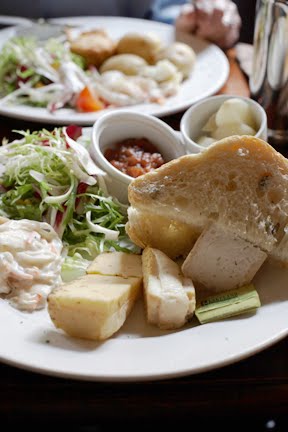
If you are fortunate enough to find yourself in an English pub (as in this picture), here’s my advice. Order a glass of the local lager and a Ploughman’s. If you are in a place that is graced with enough culinary consciousness to make this basic staple into something sublime, a large rasher of very fresh bread will be accompanied by some local cheeses (in this case some Stinking Bishop and two other cheeses that were equally delicious but not so memorably named), some chutney and a pickled onion or two (this one was thoughtfully cut into quarters so that I didn’t have to embarrass myself by trying to negotiate something so round and slippery with a knife and fork….. in England one NEVER uses one’s fingers), a polite portion of coleslaw and a bit of fresh salad. Civilization on a plate. Basic, satisfying and, if local ingredients are used, even surprising. The cheese was a revelation. I’ll never pass on the opportunity to encounter some Stinking Bishop again.

Sunday, September 12, 2010

Basil and Heaven


Not quite sure where this summer went, but today it was cool enough to want the windows closed. Time to harvest the wealth of basil still outside and capture some summer souvenirs as consolation for when the weather is truly chilly. According to Wiki, the ancient Egyptians and Greeks believed that basil would open the gates of heaven for people passing on. Makes sense to me. Basil itself is heavenly.

If you don’t have a pot of this miracle in your garden or on your fire escape, you may still be able to pick up a nice fat bunch at the farmer’s market. It’s easy to preserve a bit of heaven (well, you can start with basil and philosophize later over sauce). Wash and dry (as in take a tea towel or salad spinner to get off any excess moisture) a large quantity of basil leaves and process them in a food processor with some extra virgin olive oil. Do this by packing the food processor with the prepared leaves and slowly (with the blade running) drizzle oil into the tube at the top. No need to measure, you want the consistency to be creamy, not too dry but soupy either. Done? Put your simple pesto into an ice cube tray and when it’s fully frozen, store the frozen basil cubes in a well-marked (date it!) bag in the freezer.

You now have passage to heaven! When the weather is truly cold, you can reclaim your basil (thaw it gently) and add it as is to soups or sauces. Or make Genoese Pesto Sauce! Follow the link until I can write again with a recipe tailored for first time pesto makers.


PS - You may have noticed (at least I hope you have) that my entries have been a little sparse lately. I haven’t given up on the blog, but will be making entries a little less frequently for a while. It’s almost a year since I embarked on Kitchen Primer, and I’m way way past 100 entries. I love doing this, but there are many things vying for attention (not the least being Sylvia, the prodigal daughter… Maybe I can get her interested in some pesto making!).

Monday, August 30, 2010

It’s a Tomato! It’s a Cherry! It’s a Cape Gooseberry!


Also known as a Ground Cherry, this super little fruit (that’s a relative of a tomatillo) references Superman in more ways than one. Apart from having a ‘Cape’ attached to it, this cherry sized fruit contains a chemical, Cryptoxanthin. But fear not! This is not Kryptonite! Cryptoxanthin converts to vitamin A, which equates with its having anti-oxidant properties. I’m sure that Superman would have enjoyed these as a snack. He would have been able to swoop down in either North or South America where these are native. When you fly around and have superpowers, this is the bonus you get for having to fight bad guys most of the time. Maybe he picked some for Lois to use in a salad or enough for her to make preserves or a pie (who knows? maybe Superman likes to cook too!).

You and I don’t need a cape or superpowers to try these. All that’s required is a willingness to try something new and a trip to the farmer’s market. Just peel back the husk and eat the berry inside. You’ll be able to report back to your friends on this planet that it’s slightly tart, slightly sweet and very mild mannered.

Monday, August 23, 2010

Uhibbu Lemon Cucumbers!


Saturday’s farmer’s market at Grand Army Plaza was packed! Pip, Pookie (Pip’s pal has been staying with us) and I ran into canine and foodie pals alike. This is one of the few venues where we can all shop together. Sterling’s people, Cat and Dave, insisted that I take home some ‘lemon cucumbers’. Who could refuse that sort of directive? We had already joined Habibi (Arabic for “Beloved”) and his person, Glenn. Glenn is a very well traveled man, who, of all the off-leash crowd (wonder what the dogs call us?) could probably explain BCE (we are about to get to that) and a few other things as well. But, for all Glenn’s erudition, lemon cucumbers were a mystery for him as well. We had a mission! One farm stand later, culinary adventures bagged, dogs and off-leash acquaintances headed back to our respective kitchens and, as it turns out, research sources. Glenn and I had the twin impulse to get home and consult greater food minds.

How do I know this? Here’s the link that Glenn sent about Lemon Cucumbers.

My favorite source, McGee, writes that cucumbers were domesticated in India around 1500 BCE which is an awfully long time ago (what’s BCE? Here’s a reference from Wiki and one from About.com). A cucumber is in the squash /cucurbit family, keeping company with, well, squashes and watermelons! Apparently, watermelons and cucumbers are related, a good illustration of pointing out the obvious…. as in, duh… of course! It never really occurred to me before, but makes complete sense now. What isn’t obvious are these cucumbers.

Make sure to wash off any little prickles left on the outside and eat whole like an apple. Alternately, if you are feeling fancy or want to share, slice them and pull out some fancy imported salt to use sparingly as a seasoning. That’s it! They taste nothing like a lemon, so it’s not about looks! It is about a refreshing, mild cucumber that is easy to eat by itself or use (skin and all) as an easy addition to a seasonal summer salad. Ah… uhibbu lemon cucumbers! (Glenn tells me that this is the companion verb to Habibi. ”Uhibbu” is the Arabic verb for ‘I love’. Apparently Glenn’s dog is a pure-bred noun.)